The Sacred History of Makeup… The Overview
(everything stated in this blog is based upon my own research, personal practice, and opinion)
Makeup has never just been makeup. It has always been a mask, a mirror, a skeleton key to the gods…and occasionally, a weapon. A streak of pigment can bless, curse, seduce, or terrify. Humans were painting their bodies long before we thought to sow fields or hammer metal into swords. The oldest known use of pigment, red ochre smudges found in Blombos Cave, South Africa, dates back about 100,000 years. That’s older than pyramids and alphabets. Those early smears weren’t about vanity. Archaeologist Christopher Henshilwood argues they symbolized blood and life force, a way to call to the ancestors. In other words, the first painted faces weren’t for flirting; they were for summoning.
And that’s the first thing worth noticing: our bodies were the original canvas, the first altar, the place where color could bridge the gap between flesh and spirit. Once humanity realized that pigment could mark the body as something more than animal, paint became a ritual technology, a way of transforming ourselves into vessels, messengers, warriors, or gods.
If anyone perfected the art of sacred cosmetics, it was the Egyptians. That sharp kohl eyeliner you recognize instantly from hieroglyphs wasn’t just chic, it was divine tech. Kohl didn’t only make eyes dramatic; it served as protection against both glare and evil spirits. Draw the line and suddenly you resembled Horus, the falcon-eyed god of vision. To resemble him was to be seen by him, to be under his protection. Priests and priestesses applied kohl before rituals not as fashion but as invocation. The cat-eye, in that world, was less about seduction and more about summoning.
Salima Ikram notes that holy application of kohl marked the priest as a vessel for the gods. In other words, it wasn’t you standing there in the temple anymore, it was a god looking out through your eyes. Think of it as eyeliner that doubled as a divine VPN, routing your gaze straight to the sacred.
In India, sacred pigment took aim at the forehead, the space between the brows where the ajna chakra, “third eye”, resides. The tilaka and bindi, made from sandalwood paste, turmeric, or the bright crimson of kumkum, were not decoration. They were spiritual GPS signals. Place a dot or a line on the forehead, and you weren’t beautifying yourself; you were sending out a devotional broadcast.
The shapes mattered. A vertical line proclaimed devotion to Vishnu. Tripartite stripes identified you as a worshiper of Shiva. The crimson bindi spoke of Shakti’s power and presence. David Frawley describes them as alignments, visible signs that body and spirit were in step with the divine. The forehead became less a patch of skin and more a portal, a marker of allegiance.
The Greeks and Romans, never shy about aesthetics, wove pigment into divine performance. Roman priestesses lined their eyes with kohl, dusted their faces with saffron, and in doing so transformed themselves into embodiments of Venus. Ovid, in his playful yet pointed Ars Amatoria, wasn’t simply giving beauty advice, he was highlighting how ritual adornment invoked the goddess herself. Here, beauty was strategy. To appear like a goddess was to attract her presence, to channel her into the world. When a priestess painted her face, she wasn’t just enhancing features. She was courting the divine. A dusting of saffron was a small but potent step in the dance between mortal and immortal.
By the time Europe entered the Middle Ages, pigment had become a loaded symbol. The Church embraced ashes, smeared each year on foreheads at Ash Wednesday, as reminders of mortality and obedience. The mark was temporary, but its meaning was eternal: you are dust, and to dust you shall return.
At the same time, folk magicians and cunning folk were painting themselves too, though their colors were herbal salves, protective oils, and pigment potions designed to shield against spirits, grant invisibility, or open the door to trance. The infamous Malleus Maleficarum of 1487 thundered against such practices, branding painted marks as signs of a pact with the devil. And yet, among the common folk, the same pigments were applied as blessings, wards, or healing tools. The line between sacred and profane, holy and heretic, was drawn in the same powders and pastes. One person’s ash mark was piety; another’s herbal paint was blasphemy. It wasn’t the pigment that carried judgment, but the hand that applied it.
In Japan, the bold designs of Kabuki’s Kumadori makeup transformed actors into gods and demons. Red signified heroic power. Blue was villainy. Black stood for immortality and spiritual strength. Once painted, the actor didn’t simply portray a role, they became it. The paint was the threshold.
Chinese opera developed its own elaborate system. Red meant loyalty and courage, black integrity and honesty, green boldness and ferocity. Audiences didn’t need programs or translations; they could read the face as clearly as scripture. In both cultures, Pigment became theater, and theater became ritual. The brush didn’t disguise the actor’s identity so much as reveal the archetype already simmering beneath the surface.
By the time Europe rediscovered its appetite for esoteric traditions in the 19th and early 20th centuries, pigment was consciously claimed as magical technology. The Golden Dawn, Aleister Crowley, and later Wiccan traditions used paint and pigment not for costume but for spellwork. Sigils, planetary symbols, ritual markings were all drawn directly on the skin.
Laura Tempest Zakroff captures this beautifully in The Witch’s Cauldron, describing how the body becomes a spell itself. A brushstroke of liner or paint wasn’t a flourish, it was an enchantment. To mark the body was to rewrite it, to shift consciousness, to create a living ritual. The magician’s skin was the canvas, the paint the spell, the body the altar.
From Sigils to Selfies: Makeup Today
And then there’s us. In our glitter-drenched, neon-lit century, pigment is still carrying the same weight, only now it shows up on Instagram feeds and at festivals. The modern phenomenon of sigil makeup, drawing runes, planetary glyphs, or lunar phases onto cheeks and brows, is not as new as it looks. It’s a continuation of the same lineage. Even outside explicitly spiritual circles, makeup still does the work. A raver’s glittering crescent moon is a direct descendant of the ochre smear. That swipe of lipstick before a hard conversation, that eyeliner sharp enough to cut through self-doubt, that biodegradable glitter smeared before stepping into a crowd…these are ritual acts. The mirror becomes a altar, the palette is a set of sacred tools, and the routine itself is a form of invocation. We might not always say we’re summoning spirits, but we’re certainly summoning selves. The power version of you, the seductive version, the fearless version, the one who can stare down gods or bosses alike, that’s ritual too. Like every culture before us, we’re still using pigment to shift states, to claim identities, to call forces bigger than ourselves into the room.
From caves to catwalks, temples to TikTok, the story doesn’t change. Makeup has always been invocation, protection, revelation. The colors shift, the tools evolve, the context moves from cave to cathedral to cabaret to anything in between, but the essence remains. We paint ourselves to be seen, not just by others, but by gods, ancestors, archetypes, even by ourselves.
Pigment is always a declaration: I am here, I am aligned, I am something more than ordinary flesh. Our ancestors were not vain for painting themselves. They were visionary. They understood what we still enact today: Pigment never merely decorates. It transforms. The next time you drag a line of kohl across your eye, or sweep blush across your cheeks, remember this: you’re standing in a tradition a hundred thousand years old. You’re not just painting yourself pretty. You’re painting yourself holy.
Whether it’s in a cave, a temple, a battlefield, a stage, or a bathroom mirror lit by bad fluorescent bulbs, the act is the same. The face is the first altar. The brush is the first wand. The paint is the oldest spell we know.
Monthly Mindfulness
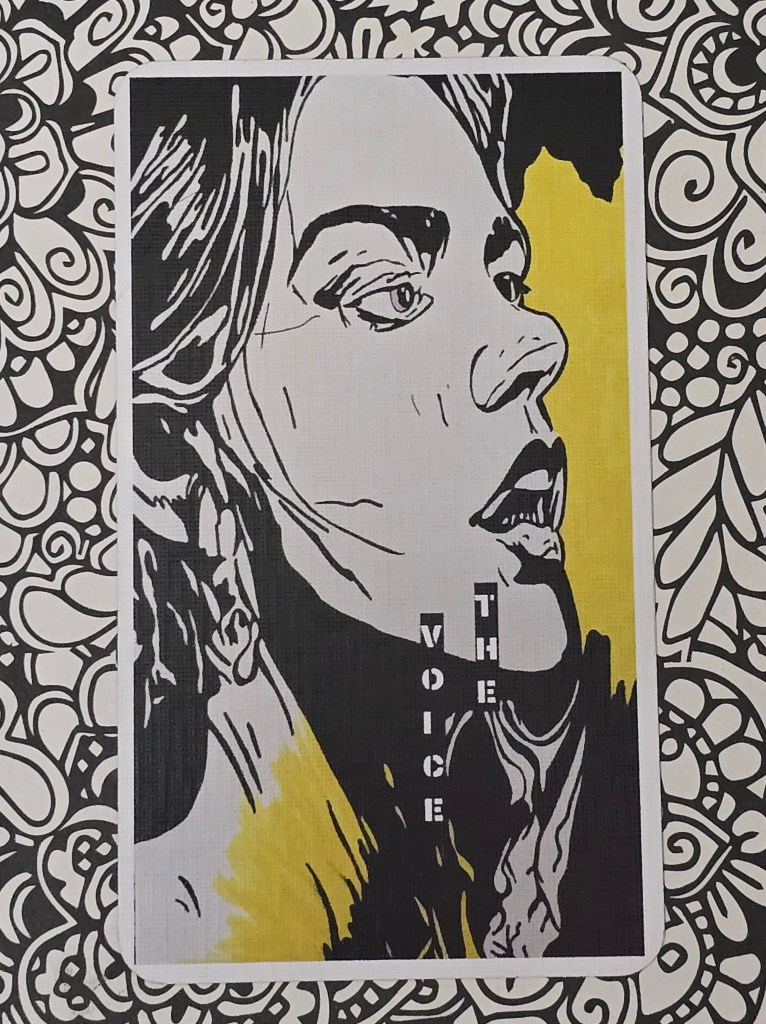
The Voice (the strength of a word)
How do you use your voice? Do you do so with confidence?
How can you use your voice for the betterment of the world around you? For the betterment of self? Finding one’s voice is an empowering moment. Using ones voice is one of the strongest tool in your wheelhouse for transformation & growth. When we use our voice with confidence we shape the world around, and within. Words have power, and you are powerful. This also counts for the voice we use for/with ourselves. Be your first supporter. When we support ourselves internally that cofidence will carry externally.
——-Oracle of Perception Grab a deck in the shop @ BuyMeACoffee.com/EmbalmedApple


 The Art of Becoming
Leave a comment