Timing Magick Without Losing Your Mind
Magick is mostly intention, a decent dash of tools, and just enough flair to make it feel like magick instead of a glorified self-help exercise. But timing, that’s where you add the spice. Think of planetary hours as the occult spice rack. You don’t need them, but the results without them can feel a little bland. Add them, though, and suddenly everything clicks into rhythm.
Most people’s first brush with planetary magick comes when they realize the days of the week are already astrology in disguise. Sunday? The Sun. Monday? The Moon. Tuesday? Mars (from Martis dies in Latin, warped into Tiw’s Day by the English). Wednesday? Mercury. Thursday? Jupiter (Thor’s Day, but really Jove’s Day). Friday? Venus. Saturday? Saturn. You’ve been chanting planetary invocations your whole life without realizing it every time you’ve said “TGIF.”
Each day has a planetary sponsor. If you want love or pleasure, Friday has Venus’s fingerprints all over it. If you want wealth, expansion, or opportunity, Thursday’s Jupiter’s turf. If you want to slam the door on something, Saturday is the perfect time to call Saturn to swing his scythe.
Now, someone always interrupts here: “But wait, the Sun and Moon aren’t planets. Why are we calling them planets?” The short answer is: because astrologers don’t use NASA’s definitions. The long answer is that the word planet comes from the Greek planētēs, meaning “wanderer.” The ancients sorted the sky into fixed stars (the constellations that don’t budge) and wanderers (the seven bright bodies that move across that backdrop). The Sun wanders. The Moon wanders. Ergo, they’re planets in the astrological sense. So when you hear “the classical planets,” it means those seven visible wanderers: Saturn, Jupiter, Mars, Sun, Venus, Mercury, and Moon.
We have met the basic cast. Now let’s talk about how their hours work.
Unlike the neat sixty-minute blocks your phone insists on, planetary hours are elastic. Every day from sunrise to the next sunrise is chopped into twenty-four planetary hours. Twelve belong to the daytime, twelve to the night. But because the lengths of day and night change with the seasons, these “hours” stretch or shrink. In summer, daytime planetary hours are longer than sixty minutes, night hours are shorter. In winter, the reverse. It’s less “hour” and more “a twelfth of the day or a twelfth of the night.” Inconvenient? Yes. Brilliant? Also… yes, because it ties your practice to the actual Sun, Moon, etc, above your head, not just a mechanical clock.
So, who gets what hour? That’s where the Chaldean order comes in. It’s the eternal sequence: Saturn, Jupiter, Mars, Sun, Venus, Mercury, Moon, and then back to Saturn again. This order is based on perceived speed and distance from Earth: Saturn slowest, Moon fastest. The system is simple once you know the trick: the first hour after sunrise is ruled by the planet of the day, and then you march forward in Chaldean order, hour by hour, round and round. If it’s Sunday, the first hour after sunrise belongs to the Sun, then Venus, then Mercury, then Moon, and so on. By the next sunrise, you’ll find the system clicks neatly into the planet that rules the new day. It’s an elegant cosmic loop.
Why does any of this matter? Because timing matters. Doing a love spell in a Venus hour on Friday layers your intention with planetary resonance. Banishing in a Saturn hour on Saturday moves with Saturn’s heaviness. Seeking clarity in a Mercury hour on Wednesday rides the current of quicksilver communication. It’s not superstition, it’s resonance, like playing music in key instead of off-key. You can play in any key you want, sure, but when you’re in tune, the whole thing vibrates differently.
Now here’s where most people start sweating: the math. But don’t panic, it’s much easier once you see the steps.
First, get your sunrise and sunset times. Your weather app will do. Then subtract sunrise from sunset to get the length of the day. Here’s the crucial step: convert that length into minutes before you divide by twelve. Hours are messy, minutes are clean.
Say sunrise is 6:00 AM and sunset is 8:00 PM. That’s fourteen hours. 14 × 60 = 840 minutes. Divide 840 by 12, and each daytime planetary hour is 70 minutes long. Now do the same for night. A full day is 24 hours, or 1,440 minutes. Subtract your 840 minutes of daylight, and you’re left with 600 minutes of night. Divide that by 12, and you get 50 minutes for each nighttime planetary hour.
Want to make sure you did it right? Here’s the trick: the length of a day planetary hour plus the length of a night planetary hour always equals 120 minutes. Always. If your sum isn’t 120, something went wrong. Fix it before you try calling Mars and end up with Mercury photobombing your ritual.
Let’s put that into action. Suppose it’s Tuesday, sunrise at 6:00 AM. The first planetary hour is Mars, because Tuesday belongs to Mars. From 6:00–7:10, it’s Mars time. From 7:10–8:20, the Sun. From 8:20–9:30, Venus. From 9:30–10:40, Mercury. Then Saturn, Jupiter, Moon, and back around. Once night falls, the sequence doesn’t stop, it keeps going, but now each planetary hour is 50 minutes instead of 70. It feels fiddly at first, but once you’ve walked through it a few times you’ll start seeing the rhythm everywhere.
Now, the classical seven planets own this system, but modern astrology gave us three late arrivals: Uranus, Neptune, and Pluto. They don’t have days or hours of their own, but occultists are resourceful, we mapped them to their lower-octave siblings. Uranus is the higher octave of Mercury. If you’re after sudden breakthroughs, radical clarity, tech magick, or flashes of genius, you work with Uranus during Mercury hours or on Wednesday. Neptune is the higher octave of Venus, resonating with dreams, mysticism, glamour, devotion, and boundary-dissolving. For Neptune, you pick Fridays or Venus hours. Pluto is the higher octave of Mars, tied to power, transformation, destruction, and rebirth. That’s Mars’s turf: Tuesdays and Mars hours. Think of them as crashing their siblings’ hours: they don’t own the house, but they’ve got a key.
Do you have to use planetary hours? No. Magick is flexible. If you’re in a rush, do the work when you can. But if you line it up with planetary timing, it feels like you’re riding a wave instead of dogpaddling in circles. If the math annoys you, yes, there are apps that will do it. Use them. Just don’t forget the structure behind the numbers, because knowing the system by heart gives you a sense of rhythm no app can provide.
In a nutshell… Planetary hours aren’t shackles, they’re spices. You don’t need them every time, but when you use them, they change the flavor. The Sun and Moon are planets in this system because they wander. The classical planets are the seven visible ones. The Chaldean order is the conveyor belt. The math check is always 120 minutes. And Uranus, Neptune, and Pluto? They’re the guests who show up late but bring something you didn’t know you needed.
Magick is about intention, yes, but it’s also about rhythm. Planetary hours remind you that time isn’t flat and mechanical; it stretches, contracts, breathes. When you work with that rhythm, you’re not just doing magick. You’re playing in key.
But Wait…There’s More!
This is just the tip of the iceberg that is planetary timing. If you would like to learn more about the nuances behind planetary timing, I suggest checking out Astrological Strategy (Celestial Timing for Success) by Bill Duvendack: https://a.co/d/1WEOPb7
MONTHLY MINDFULNESS
I have flipped to full moon pulls for the new season, and will be using my upcoming Walking With The Gods icon deck (Kickstarter in May – Stay tuned for more info!).
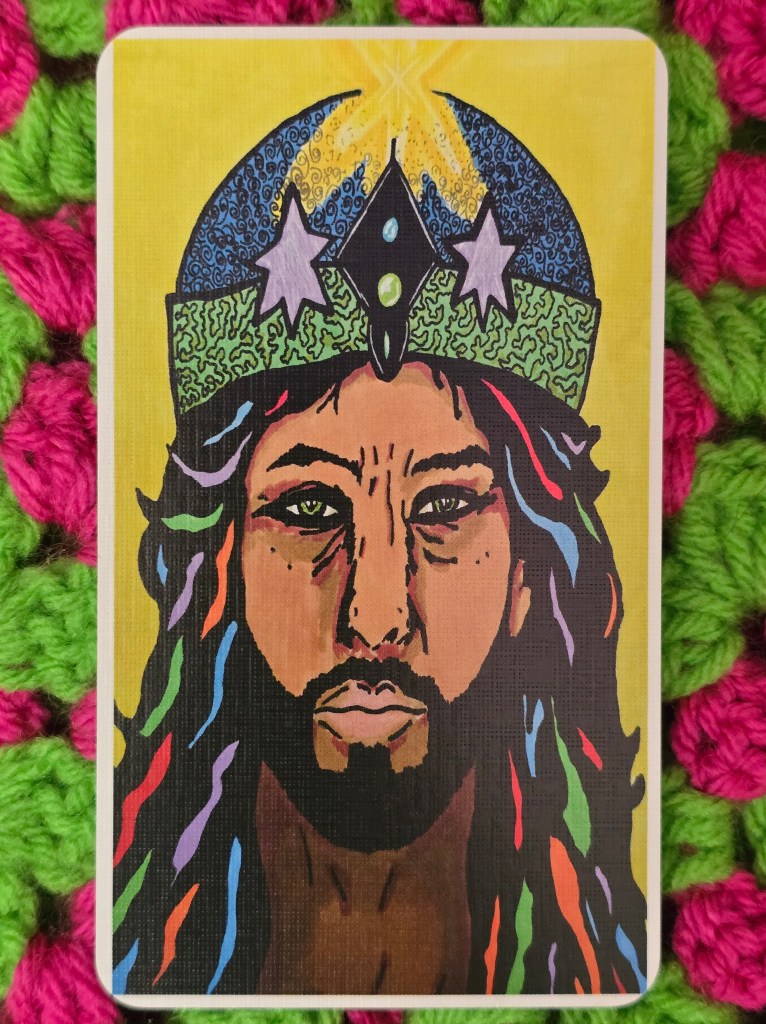
Lucifer
In esoteric and occult traditions, Lucifer is not a figure of evil, but a symbol of illumination, rebellion against ignorance, and the quest for divine knowledge. He represents the inner spark of consciousness that dares to question, to seek truth beyond dogma, and to awaken the soul to its own divinity. In this sense, Lucifer is the archetypal bringer of light, not to destroy, but to enlighten, to tear down falsehoods and reveal the hidden.
To many modern mystics, Lucifer embodies the Promethean spirit: the one who challenges oppressive authority and offers humanity the fire of wisdom, even at great cost. He is the liberator of mind and will, the light in the darkness, the courageous defier of blind obedience.
Like the planet Venus as it rises in the morning sky to herald the dawn, Lucifer is the light that awakens. He is the radiant herald of inner truth, and the luminous guide on the path to self-realization. He is wisdom as sacred flame; not destroyer but revealer, not shadow but spark. He calls you to have the courage to see, the will to know, and the radiance of truth unchained.
I find it fitting that this card came up today. The full moon in Aries blazes with raw ignition energy: bold, impatient, and unapologetically alive. It’s the cosmic flint strike that says, “Stop waiting, start being.” Aries governs beginnings, self-assertion, and rebellion against stagnation; under this lunation, emotion meets action in a flash of divine defiance. In the mythic mirror, this perfectly echoes Lucifer, not as the villain, but as the archetype of illumination through rebellion. Just as Lucifer fell to rise in knowledge, Aries’ fire burns through conformity to reveal authentic will. Both embody the courage to stand alone, to challenge divine order, and to claim inner sovereignty.
 The Art of Becoming
Leave a comment