Building the Inner Sanctum
(everything stated in this blog is based upon my own research, personal practice, and opinion)
The idea of the astral temple keeps resurfacing across magical traditions. Not because it’s flashy, or trendy. The astral temple sticks around because it works. Quietly. Relentlessly. Often far more deeply than people expect.
The astral temple is a sanctuary that exists beyond brick, mortar, incense smoke, and candle wax. It’s an intentionally built inner space that’s created through imagination but functions as a real, stable environment for magical work, spiritual contact, and personal transformation. You shape it with imagination, fuel it with will, and strengthen it every time you return to it. Think of it less like a fantasy palace and more like a metaphysical workshop that slowly comes alive the more you actually use it.
Too many get tripped up right out of the gate. They hear astral and immediately assume we’re talking about escapism, daydreaming, or some woo-adjacent aesthetic exercise. This misunderstanding alone has probably kneecapped more magical practices than skepticism ever did. The astral temple isn’t a mental vacation home. It’s infrastructure. It’s where ritual coherence is built, where symbolic language gets trained into muscle memory, and where the magician learns how to hold space without relying on external props.
I’s not “just imagination.” That phrase gets tossed around as if imagination isn’t the primary interface through which magick operates in the first place. The astral plane, however you define it within your cosmology, is the realm of thought, emotion, symbol, and archetype. It has its own logic, its own inhabitants, and its own physics. When you build a temple there with consistency and intention, you’re not pretending something into existence. You’re stabilizing a thoughtform and anchoring it within a larger psychic ecosystem. Treat it like a joke, and it behaves like one. Treat it like sacred architecture, and it starts acting accordingly.
What makes the astral temple particularly powerful is its reliability. Physical temples are wonderful, but they’re also subject to reality. You need privacy. You need time. You need materials. You need a cooperative living situation. The astral temple doesn’t care if you’re traveling, exhausted, or living in a shoebox with thin walls. It’s always accessible. It becomes a constant point of return; a place where your magical posture stays intact even when life is messy.
Accessibility is only part of the story. The real work begins when you realize what the act of building the temple actually trains. Visualization is disciplined imagination. It’s the ability to hold detail, maintain symbolic coherence, and sustain focus without drifting off into narrative nonsense. If your inner imagery collapses every time you look away, that’s not a personal failing, but rather it’s a diagnostic tool. The temple shows you, very clearly, where your attention fragments and where your will needs strengthening.
Over time, the temple develops energetic density. Repetition leaves an imprint. Symbols gain weight. The space starts to feel “occupied” in the way well-used ritual rooms do. This is when the temple begins responding. Spirits recognize it. Archetypal forces behave differently within it. Your own subconscious stops treating it like a thought experiment and starts treating it like a functional environment. Astral work stops feeling abstract and starts feeling… operational.
This isn’t a replacement for physical magic; It’s an amplifier. A parallel structure. A backstage area where you can test, refine, and rehearse without burning through materials or second-guessing every step. Rituals performed in the astral temple still register. They still affect your psyche, your subtle body, and your energetic field. In some cases, they hit harder because there’s less sensory distraction and more symbolic precision.
One of the most underrated functions of the astral temple is how it evolves alongside you. This isn’t a static build. It’s a living structure that reflects your initiatory process whether you consciously update it or not. Doors open when something integrates. Altars change when your relationship to a force matures. Entire rooms appear after major breakthroughs. You don’t have to psychoanalyze every change, but you should pay attention.
Traditionally, inner sanctuaries like this show up everywhere once you know how to look. Hermetic Qabalah maps reality itself as a navigable internal structure, and advanced practitioners don’t just study the Tree of Life, they move through it. Golden Dawn initiations relied heavily on imagined ritual spaces long before students were trusted with physical temple work. Tibetan Buddhism constructs entire deity palaces in meditation, complete with architectural precision, because form itself becomes a vehicle for realization. Shamanic traditions describe inner landscapes with remarkable consistency, passed down through lineage.
This isn’t a modern invention or a New Age indulgence. It’s a cross-cultural solution to the problem of “how do you create a stable interface between the human psyche and transpersonal forces?”
Once the temple exists, what you do with it is limited only by your discipline and symbolic fluency. Daily practice becomes possible even when circumstances aren’t ideal. Pathworking and astral travel become safer and more coherent when you’re launching from a familiar, contained environment. Spirit communication becomes clearer when meetings happen in a space that’s already attuned to your magical language. Healing work gains structure instead of dissolving into vague intention-setting. You can use the temple as a testing ground. Before performing a complex physical ritual, run it astrally. You’ll notice immediately where energy snags, where symbolism clashes, or where your confidence falters. That feedback loop alone saves an incredible amount of wasted effort.
Building the temple doesn’t require artistic genius or encyclopedic symbolism. All it really requires is commitment. Start with a form that actually resonates with you, not one you think you’re “supposed” to use. Classical temple, forest clearing, stone hall, subterranean sanctum… it doesn’t matter as long as it feels symbolically grounded. Early on, simplicity is a strength. Overdesigning is a classic beginner trap.
Establish basic features with intention. An altar that actually functions as a focal point. Directional markers that anchor elemental forces. Boundaries that define what belongs inside and what doesn’t. Return to it regularly. Walk through it. Interact with it. Engage your senses. Consistency matters more than intensity here.
At some point, the temple should be inaugurated. Not because it’s dramatic, but because thresholds matter. A dedication ritual marks the space as sacred and signals to your psyche, and anything else listening, that this isn’t casual imagery anymore. From that point forward, treat it accordingly. This is not where random fantasies go to play dress-up. Maintenance is part of the work. Clean the space. Banish what doesn’t belong. Don’t let it stagnate. A neglected astral temple becomes just as useless as a neglected physical one, and often reflects the same internal avoidance patterns.
As your practice deepens, the temple naturally expands. Libraries appear. Healing chambers form. Ancestor halls, planetary vaults, or shrines to specific forces take shape. Some additions are deliberate; others emerge after initiatory pressure reshapes your inner landscape. Let it happen, but don’t let it sprawl without coherence. Symbolic clutter is still clutter.
One of the most important roles of the astral temple is how it forges will. Real will, not desire cosplay. Will as the ability to hold intention steady, align internal forces, and act without fragmentation. The temple gives that Will a physicality. Thought becomes architecture. Intention becomes structure. Over time, this bleeds into your outer life in ways that are impossible to fake.
If the temple is unstable, foggy, or constantly changing without reason, that’s information. It’s showing you where your attention leaks, where your emotional regulation slips, where your symbolic language needs refinement. Fixing the temple fixes more than the temple.
That said, this kind of work has real pitfalls. When imagination stops being disciplined, the practice slips into escapism, and the power drains right out of it. Invasive thoughtforms become more noticeable as inner perception sharpens. Stagnation sets in when people build the temple once and then abandon it. Symbolic overload happens when everything meaningful gets shoved into the same space without synthesis. None of these are moral failures, but they are maintenance issues.
The astral temple isn’t separate from you. It’s a reflection of your internal architecture made visible. It is a fortress, a forge, a sanctuary, and sometimes a mirror that doesn’t lie. When cultivated with seriousness and care, it becomes one of the most effective tools for sustained magical work and inner transformation. The astral temple meets you exactly where your discipline is. No more. No less. It waits patiently until you’re ready to step inside and actually build something that lasts.
———————————————————————————-
MONTHLY MINDFULNESS
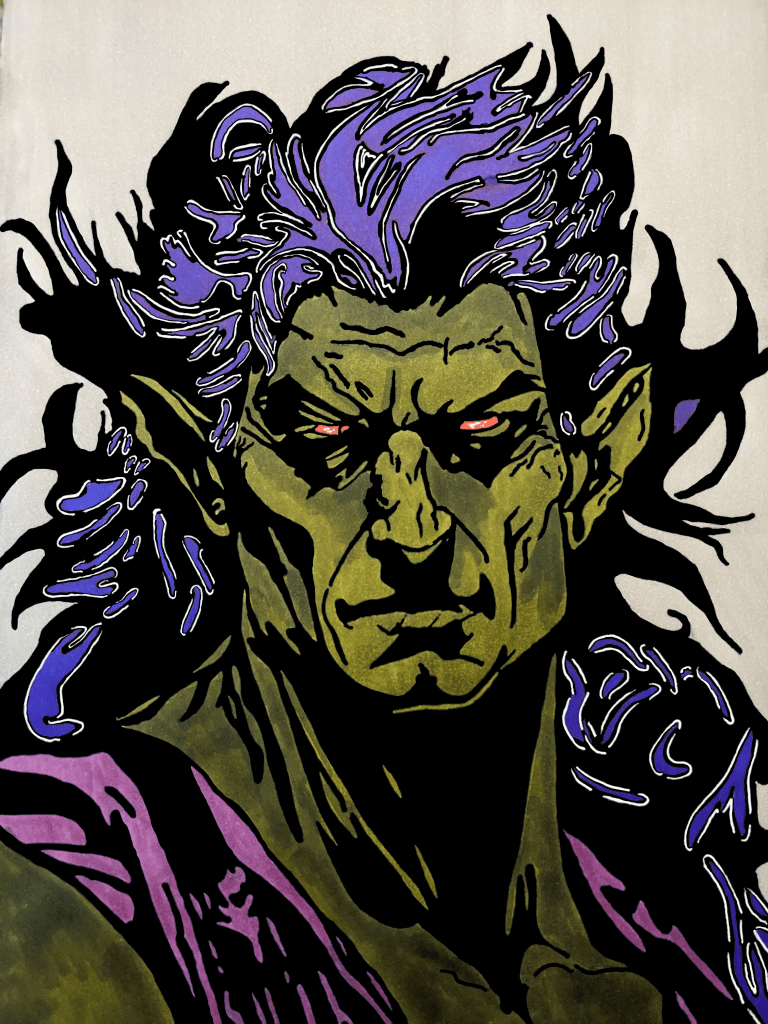
(From the Upcoming Walking With the Gods Icon deck – on Kickstarter in May)
Hades
The ancient Greek god of the underworld and ruler of the dead. Often misunderstood as a dark or malevolent figure, Hades is, in truth, a solemn and just deity who governs the realm of the afterlife with balance, order, and impartiality. As one of the three great sons of Cronus and Rhea, Hades drew dominion over the unseen world beneath the earth when the cosmos was divided.
Though rarely worshipped in public temples, Hades was deeply respected and often invoked with reverence and caution. Known as Plouton (“the Wealthy One”) in later times, he was associated not only with death but also with the hidden riches of the earth: precious metals, fertile soil, and the mystery of regeneration. His presence signifies both finality and continuity in the eternal cycle of life, death, and rebirth.
Hades is not a tormentor, but a guardian and keeper of souls. His realm is orderly, and he ensures that all who enter receive what is due. His myth with Persephone, whom he takes as queen, speaks to themes of descent, transformation, and seasonal change. Hades represents the sacred boundary between worlds, the still and enduring force that governs the deep mysteries of life beyond life.
This card bring to the table the following contemplations:
What rules, unseen, from the shadows? Acknowledge endings and continuance. The wealth you seek is hidden in shadow, and regeneration is born of stillness. Descent is initiation, and sovereignty through silence. Seek justice without favor. Fear not the threshold where life surrenders to mystery, and mystery returns as life.
 The Art of Becoming
Leave a comment