The Gatekeeper of Tradition
The Fool’s Journey Through the Major Arcana, Part 6 of 22
(everything stated in this blog is based upon my own research, personal practice, and opinion)
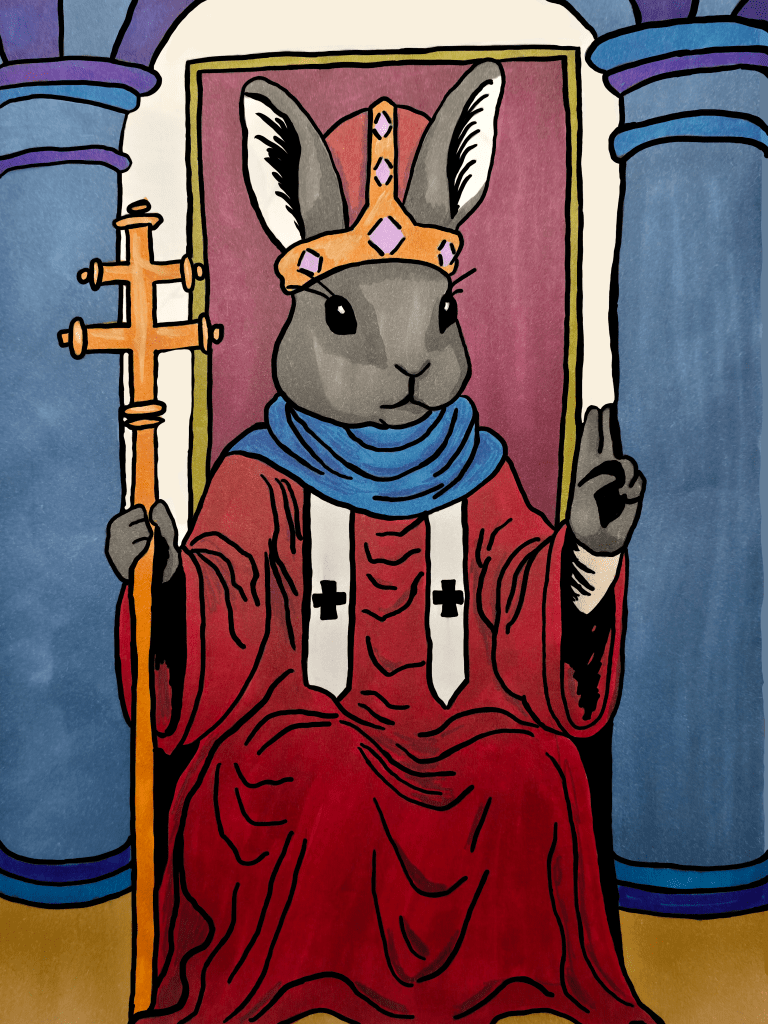
(The Hierophant from the upcoming Tarrot deck)
The Fool steps into the unknown guided by instinct and curiosity, completely unburdened by rules or expectations. The Magician reinforces that sense of autonomy, showing that everything needed to create and shape reality already exists within. The High Priestess pulls everything inward, emphasizing intuition, inner knowing, and the quiet voice that doesn’t need external validation. The Empress expands outward into growth, abundance, and nurturing, showing how life flourishes when it is supported and cared for. The Emperor then comes in and demands structure, discipline, and responsibility, forcing everything into a tangible, functional form. By the time you reach the next card, you might feel like you’ve figured something out about how to exist in your own power. You’ve explored, you’ve built, you’ve defined yourself… Then, the Hierophant arrives.
The Hierophant asks a simple but uncomfortable question. Where did all of this come from? Not just your ideas or beliefs, not just your practices, but the very framework you’re using to understand your life. The Hierophant introduces the reality that you did not create yourself in a vacuum. Everything you know, everything you value, and everything you think you’ve independently discovered has roots. Those roots might be cultural, spiritual, intellectual, familial, or historical, but they exist whether you acknowledge them or not. The Hierophant shows these things don’t limit, they ground.
There is a strong cultural narrative around being self-made, carving your own path, and rejecting anything that feels imposed or inherited. There is a value to this, especially when it comes to questioning outdated systems or breaking free from harmful structures. Just remember that there is a difference between independence and isolation. The Hierophant is not here to take away your independence. He shows you that true depth comes from understanding the systems you are part of, not pretending they don’t exist.
The Hierophant represents initiation. The deep engagement that transforms you, standing at the threshold between curiosity and commitment. You’ve been exploring, experimenting, and trying things on to see what fits. The Hierophant asks you to take something seriously. He wants you to stop skimming and start studying. He nudges you to move from interest to devotion. Such a shift is often uncomfortable because it requires letting go of the idea that you can master something without submitting to the process of learning it.
Hell… even the word “submit” is going to make people uncomfortable. This is not about giving up power or autonomy. This is recognition that mastery requires structure, repetition, correction, and guidance. Mastery requires you to step into the role of a student, even if you are used to being self-directed. The imagery often associated with The Hierophant includes figures kneeling, which gets misread as blind obedience. In reality, these figures represent readiness and willingness to learn from something larger than the current understanding. They represents humility, not weakness.
Humility is an often-overlooked aspect of growth. It is not about thinking less of yourself, it is understanding that you don’t know everything yet. In a world where information is constantly available it’s easy to confuse familiarity with mastery. Yes, you can access endless knowledge with a few clicks. You can read about something. You can watch videos about it, talk about it, and feel like you understand it. The Hierophant calls that out without hesitation. Knowing about something is not the same as knowing it. Real understanding takes time, engagement, and context.
Context is an important gift offered by The Hierophant. Without it, knowledge becomes fragmented. You end up with pieces of information that don’t connect, ideas that don’t fully land, and practices that don’t integrate into your life in a meaningful way. The Hierophant provides a framework, a structure that allows everything to make sense. It connects ideas to history, practice to meaning, and individual experience to collective understanding.
Tradition is often associated with stagnation, outdated beliefs, and systems that refuse to evolve. Again, there are valid reasons for that perception. The Hierophant challenges you to look deeper. Not every tradition is useless. Not every system is broken. Some of the things that have been passed down have survived for a reason. They hold something that has been tested, refined, and carried forward because it works on a level that goes beyond surface understanding.
The key is discernment. The Hierophant does not ask you to accept everything you inherit. He asks you to understand it. There is a difference between rejecting something because you have examined it and found it lacking (intentional), and rejecting something because you never took the time to understand it in the first place (reactive). The Hierophant pushes you toward intentional engagement He asks you to question, explore, and challenge, but from a place of knowledge, not assumption.
This process of engaging with tradition, understanding it, and then deciding what to do with it is what allows growth to happen on a deeper level. You are not just consuming ideas, you are interacting with them. You are shaping them, and in turn, they are shaping you. That relationship is what creates depth. Without it, you are left with a surface-level understanding that never fully integrates into your life.
The Hierophant also brings the concept of belonging. Belonging is often misunderstood as conformity, or losing yourself in order to fit into a group or system. True belonging is not about erasing individuality. Belonging is placing individuality within a larger context. It is about understanding that you are part of something bigger, and that this connection does not diminish who you are, it enhances it.
Without belonging, individuality can become unanchored. It can turn into a constant search for identity without ever landing anywhere. You keep exploring, redefining, and shifting, but nothing sticks. The Hierophant offers stability, and shows that connection and individuality are complementary, not opposites.
This is important in a culture that often glorifies isolation under the label of independence. The idea that you have to figure everything out on your own, that relying on others is a weakness, or that belonging is limiting. All of these ideas get challenged here. The Hierophant shows that learning in isolation can only take you so far. Growth is often accelerated through connection, guidance, and being part of something that extends beyond your individual experience.
This does not mean blindly following others or giving up your ability to think critically. Critical thinking becomes even more important within this framework. The Hierophant expects you to question and evaluate. He expects you to decide what aligns with you and what does not. He also expects you to do that from a place of understanding, not from a place of reaction.
Learning from someone who has already walked the path you are on can provide insight that you would not arrive at on your own, at least not without significantly more time and trial and error. The Hierophant represents that exchange of knowledge. He is not the source of truth, he is the conduit. He connects you to something larger than yourself.
This connection is essential because it prevents the journey from becoming entirely self-referential. Without The Hierophant, everything revolves around your personal experience. With him, the journey expands to include the collective. It becomes about how you fit into a larger system, how you contribute to it, how you are shaped by it, and how you shape it in return.
are not just responsible for your own growth, you are part of a chain. What you learn, what you carry forward, what you pass on… all of it matters. The Hierophant shifts your perspective from being a seeker to being a participant in something ongoing. You are not just taking from the system, you are contributing.
Ritual plays a significant role here as well. Ritual is what grounds knowledge into action. It is what takes abstract ideas and makes them tangible. It creates consistency, which allows understanding to deepen over time. Whether it is a daily habit, a structured practice, or a meaningful routine, ritual reinforces the connection between what you know and how you live.
Without that connection, knowledge remains theoretical; it never fully integrates. The Hierophant emphasizes the importance of living what you learn, not just thinking about it. It is not about how much you know, it is about how deeply that knowledge is embedded in your actions, your decisions, and your way of being.
The Hierophant also warns against rigidity. When taken too far, his energy can become dogmatic. It can turn into blind adherence to systems that no longer serve growth. It can create environments where questioning is discouraged and conformity is enforced. This is the shadow side, and it is important to recognize it. The goal is not to become trapped in tradition, but to engage with it in a way that allows it to evolve.
Balance is key. The Hierophant exists between extremes. Between independence and belonging. Between tradition and innovation. Between structure and flexibility. He asks you to navigate that space thoughtfully. To take what is valuable, to question what is not, and to remain open to growth without losing the foundation that supports it.
In modern life, this shows up in countless ways. It is the difference between casually engaging with something and committing to it. It is the difference between collecting ideas and actually integrating them. It is the difference between trying to figure everything out alone and being open to guidance. It is the difference between rejecting systems outright and understanding them well enough to improve them.
The Hierophant is about connection. Connection to knowledge, tradition, community, and something that extends beyond your individual experience. He does not take away your autonomy, he gives it depth. He does not limit your path, he provides the context. He does not ask you to conform, he asks you to engage. Engagement is where the real transformation happens.
—Enjoying the bunnies of the Tarrot deck? The Kickstarter dual release of the Walking With the Gods icon oracle deck, and The Tarrot deck goes live May 21, 2026


Leave a Reply